top of page
Widnes Dock


Steam cranes on the south side of Widnes Dock. A variety of open wagons stand on the dockside beyond. The decision to concentrate rail traffic to Garston was soon to seal the fate of the Widnes Dock.


Widnes Dock looking north in the early 1920's shortly after it had fallen out of use. On the far side of the dock can be seen a loading system that had been used to transfer coal from rail to water.

The No. 1 Coal Tip on the north side of Widnes Dock carries a plate identifying it as LNWR 4086. The dock closed in 1933 and little if any coal went through this dock after coal handling facilities were provided at Garston, but in this view believed to have been taken around closure, the coal tips look to be in working order and a coal wagon is poised beyond the far tip. Open wagons with sheeted loads of timber can be seen in the distance.

A crane is used to transfer rail cargo from St. Helens, to ship to Liverpool via Widnes Dock, Spike Island, 1920's.

The remains of a rail wagon tipper which would have been mounted onto a fixed base at Widnes dock. The equipment operates by positioning a loaded wagon onto the tipping cradle. The cradle secures the wagon with curved metal arms, then tilts the wagon forwards. Gravity releases bulk coal into the ship hold, this allowed for fast unloading of coal for shipment along the River Mersey to Liverpool. This method was later questioned however as a lot of coal was damaged as a result of this process.

Tolls and charges for Widnes Dock, 1833.

An Accident report from Widnes Dock, 1841.


Widnes Dock, opened August 1833, is officially recognised as the world’s first railway dock, the first purpose-built facility directly connecting rail and water transport.
Built by the St Helens & Runcorn Gap Railway Company, its purpose was to transfer coal directly from rail wagons to ships, cutting costs and speeding up supply chains.
It pioneered the rail-to-ship concept that revolutionised global trade,

A view of the entrance to the Wet Dock, Spike Island, c1920's.
Built with an estimated cost of £31,520 the dock was filled in by 1929, later to be excavated in 1979.


A survey for LNWR at Widnes Dock, 1865.

A long-disused relic of the war between the railway and the canal company is this dock, built by the railway company alongside the canal locks where they emptied into the River Mersey, 1963-2026.

The district was described in the 1841 Census as:
‘Widnes Dock where families of the ‘flatmen’, a very low class, unsettled in their behaviour, pass much of the time on the ‘flats’ or ‘barges’. Picture taken 1920's.

Chimney's as far as the eye can see, Widnes Dock, 1920's.

Coronation, 1901.
The house occupied by the Dock Warden decorated for the Coronation of Edward VII, St. Helen's Canal, Spike Island, 1901.

Widnes Dock Labourers, c1900s.
Widnes docks opened in 1833 and these men worked hard loading and unloading cargoes and carrying out general labouring work.
Back L to R W. Prescot, W. Farmer, J. Appleton, T. Nevitt, J. Griffiths, T. Roper, J. Hunt, N.B. Harper.
Middle L to R J.H. Harper, N. Griffiths, T. Clarke, T. Sayle, T. Morris, S. Myers, W. Bee, P. Cooper, W.J. Harper, J. Woods.
Bottom L to R T. Haynes, I.N. Raves, A. Worrall, J.Walker, G. Glover, R. Anderson, I. Jones.
Dock Workers

This house belonging to the Dock Warden, Widnes Dock, 1900's.
In the early days of the chemical industry most of the housing development was centred on Spike Island, rather than ’true' West Bank as that was where all the work was.
Spike Island got it's name to the fact that a ‘spike’ was a cheap boarding house of the kind that would have been plentiful around the factories.
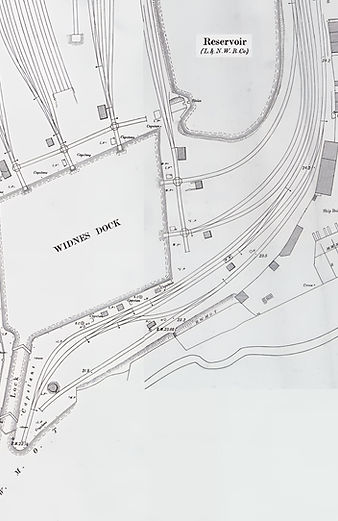
A map of Widnes Dock, 1890.
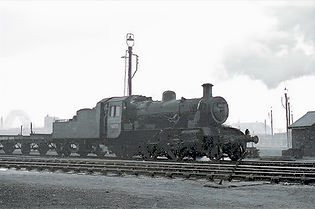
Standard Class 2 2-6-0 78035 is seen shunting on Marsh Sidings, The sidings complex too are a distant memory and now form part of the Spike Island public open space. Of note in the background is the new bridge crossing the Mersey and the Transporter Bridge to its left, 1962.
bottom of page