top of page
Crossing the Iron Bridge

The swing bridge where now stands
"The New Bridge" Spike Island 1950's.

The swing bridge is an adventure playground for these children at Spike Island, 1955.


Having completed its shunting in the sidings 78035 crosses the swing bridge back towards Widnes Dock Junction. The two signal box style levers just visible to the left were for controlling the bridge. The new crossing and the transporter bridge are both visible in the background as are numerous wagons in the sidings. 1962.

The remains of the swing bridge which carried the railway onto Spike Island, across the Sankey Canal. The capstan in the foreground, by which the bridge was turned, bore the casting, HAIGH IRON WORKS 1832. Picture taken in the late 1950's.
A map showing the Iron/Swing Bridge,
Spike Island, 1890.


An advertisement from the Warrington Guardian.
dated Saturday, July, 29th, 1865.
Please download our pdf file for:
Widnes dock, Dame-School, 1839-1862.

A Steam train passes over the Sankey
Canal from Spike Island, c1930's.
(AI Generated video)

The directors of the St. Helens Railway, accompanied by their engineer, paid a visit of inspection to the works of the railway and dock, now well in hand, and ordered the construction of two “swivel” bridges over the Sankey Canal, near Widnes Wharf and a similar bridge over the canal at Pocket Nook, St. Helens. This seems to be the first mention of a swivel or turning bridge in connection with railways in Britain, therefore the World, 1831.

All that remains of the original Iron Bridge turntable.

Gossages Tallow Mill, Sankey Canal, 1920's

For Sale, The Commercial Inn & Schoolhouse, 1859.
Bower's Brook
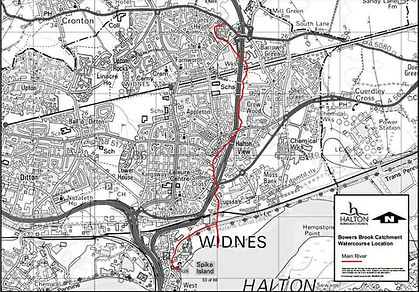
A map showing the original path of Bower's Brook and the diversion in 1873.
Parliament Session, Widnes Canal, Dock and Railways, 1873.
A diversion of the stream called Bower’s Brook or Pool, such diversion commencing at a point in the said brook or pool 30 yards or thereabouts to the north-east of the centre of the office attached to the weighing machine belonging to the London and North-Western Railway Company, near the entrances to Messrs. Gaskell, Deacon, and Co.’s Alkali Works, and Messrs. John Hutchinson and Co.'s No. 2 Alkali Works, and terminating by a junction with the same brook or pool 48 yards or thereabouts below the point at which such brook or pool issues from the tunnel or culvert which conveys it under the premises of Messrs. Hutchinson and Co., which diversion will be wholly situate in the said township of Widnes.
And notice is hereby further given, that printed copies of the Bill for effecting the objects aforesaid, or some of them, will be deposited in the Private Bill Office of the House of Commons, on or before the 21st day of December next.
Dated this 14th day of November, 1872.
Simpson and North, Liverpool, Solicitors for the Bill.
H. E. Brown, 11, Pall Mall East, Parliamentary Agent.
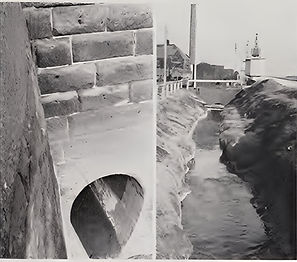

Bower's Brook 1950's & present day.
Right. The open Brook as it passes the former site of Frederic Muspratt's, Wood End Works. At this part the Brook runs parallel to the “New Cut," which is to be seen at the extreme right of the picture.
Left. All that remains of the former Bower's Brook Pool, the exit culvert of Bower's Brook into the Mersey.
This trout stream of pre-industrial Widnes has served for a century as the Cloaca Maxima, the chief chemical sewer of the Canal Region of the Widnes Chemical Industry.

Spike Island, before Bower's Brook, 1847.

Bower's Pool, 1921.

An application submitted By John Hutchinson, dated 1859.

Anchor 1
bottom of page